
A Brief Astrology History: The Return and Fall of Astrology in Europe (1100 CE – 1800 CE) William Lily and Claudius Ptolemy
- Christy in Crispy Astrology
- 2025年9月29日
- 讀畢需時 2 分鐘
已更新:2月4日
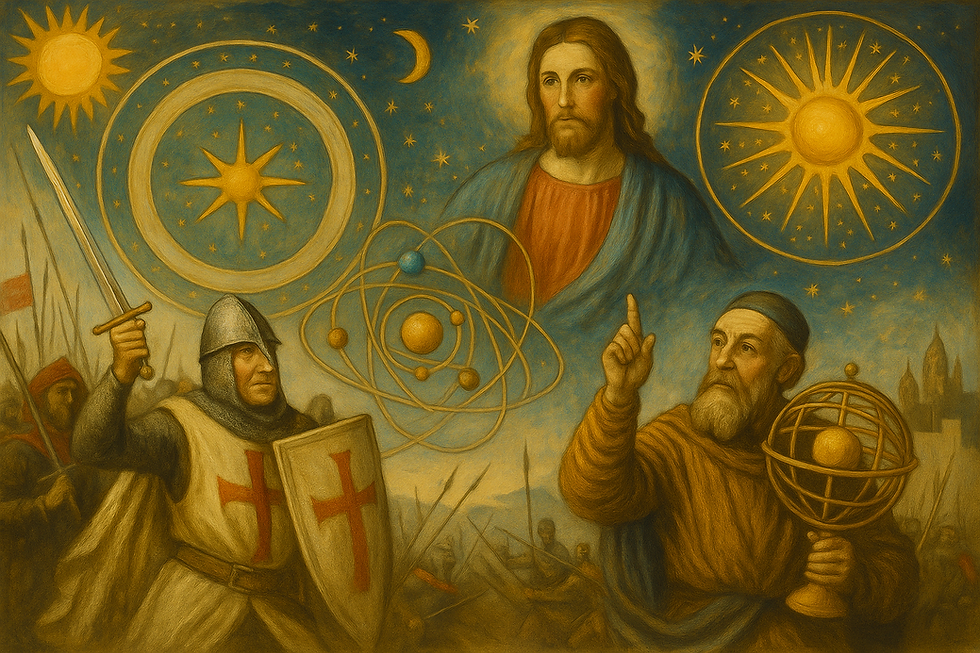
After the Crusades, Europeans slowly regained lost territories. In the 15th century, with the invention of the printing press, astrological works could be mass-produced. Translations of Arabic astrological texts into Latin began circulating in Europe. In 1453, the fall of Constantinople released a wave of Hellenistic manuscripts. These texts re-entered Europe, fueling a new classical revival and renewing interest in Platonic philosophy and Hermeticism.
Hermeticism is deeply linked with astrology. As a result, astrology exerted a profound influence on Renaissance Europe. In the 17th century, William Lilly published Christian Astrology in English—rather than in Latin, the scholarly language of the time—which inspired other astrologers to write textbooks in English as well.
In his work, William Lilly drew from sources such as Claudius Ptolemy of the 2nd century, Masha’allah of the 8th century, and Guido Bonatti of the 13th century. Whenever Masha’allah and Bonatti’s theories conflicted with Ptolemy’s, Lilly would dismiss them with the attitude: “Ptolemy is the oldest and most authentic, so he must be right!”
In reality, Ptolemy himself had a rebellious spirit. He proposed many new theories that challenged tradition, setting himself apart from contemporary astrologers like Vettius Valens and Dorotheus of Sidon. By contrast, Arab astrologers were more strongly shaped by traditional Hellenistic astrology—meaning that Masha’allah’s theories were actually closer to the original tradition than Ptolemy’s. In other words, Lilly—ironically—ended up embracing an influence that was neither ancient nor “pure.”
Although astrology briefly flourished in 17th-century England, Western astrology overall began another decline during that century. The Scientific Revolution advanced astronomy, leading scholars to realize Ptolemy’s cosmology was flawed. Ptolemy had placed the Earth at the center of the cosmos, but the Scientific Revolution demonstrated that the Sun is at the center of the solar system. This discovery made scientists question all of Ptolemy’s teachings.
Yet Ptolemy was also the very reason astrology managed to survive for centuries in the Christian world. By integrating astrology with other sciences, he introduced the idea that “the stars influence human life as part of nature’s normal workings.” Before that, celestial bodies were seen only as bearers of “omens,” not as forces that actually caused events.
This perspective allowed astrology to avoid being condemned as “magic” or “heresy” and instead to persist as part of the “natural world created by God.”
Of course, scientific progress was one reason for astrology’s decline, but not the only one. In the turbulence of science, politics, culture, and religion at the time, astrology found itself in an increasingly unfavorable position. Intellectuals no longer valued the discipline, universities stopped teaching it, and astrology ceased to be regarded as true knowledge.